
The Untraceable

Edward Lorenz did not set out to write a parable. In 1972 he gave a talk with a question for a title, asking whether the flap of a butterfly’s wings in Brazil might set off a tornado in Texas. The phrase escaped the room and became something he never quite meant. People took it to mean that small causes have large effects, which is true and unremarkable. What he meant was stranger and harder to live with. In a system sensitive to its starting conditions, the line from cause to effect cannot be traced. Not that it is difficult. That it cannot be done. You cannot stand at the tornado and walk the thread backward to the wing. The connection is real and permanently out of reach.
This is the part we drop when we repeat the phrase. We keep the flattering version, the one where a small kindness ripples outward in widening circles we can almost picture. We lose the version where the circles are real and invisible, where the thing we did surfaces somewhere downstream long after we have forgotten doing it, in a person we may never see again, in a shape we would not recognize as ours.
The thread came back for me once. I still could not follow it.
I was a tall kid in Ohio, lanky early, which let me throw harder than the other boys my age. At thirteen I was something of a Little League star. I threw fastballs and some of them got away from me. A wild pitch is forgotten before the next batter steps in. That is the whole nature of it. It costs the thrower nothing and is gone.
I was forty-three, in a hotel elevator in New York after a long day of meetings, when a man on the same ride said my name with something sharp in it. “You’re Andy Patrick.” I turned to see whether the assassins had finally caught up with me. Instead there was an ordinary man looking at me with plain disgust. “You don’t remember me, do you.” No. “Little League. Kettering Tire was your team.” He rolled up his left sleeve and pointed to a place on his forearm. “That’s where you hit me. A fastball. I still have the scar. See?”
I looked. What I saw was exactly what I had seen on that field thirty years before. Nothing.
But the memory in him had mass. It had kept its shape for three decades while mine had not held it for a single inning. The asymmetry asked for something, respect at least, some recognition that the thing he had carried all this way was real even though I could not find it. “I’m so sorry, man. I—”
The doors opened. He walked out, as unsatisfied as he had been the day he walked to first.
We tend to imagine our influence as proportional. Large acts for large consequences, small acts for small ones, the ledger balanced and legible. The arithmetic is wrong. A pitch that got away costs nothing and is forgotten by the next batter. It can also become the one scar a man still points to thirty years on. A sentence offered in a hallway and forgotten by lunch can reorganize a stranger’s afternoon, or year. A flicker of impatience can do the same. The size of the gesture tells you nothing about the size of what it carries forward, and you are given no receipt.
So we forget. Some of the forgetting is time, the ordinary erosion of days. But most of it is the structure itself. There is no thread to hold because the thread was never available to us. We could not have followed it had we tried, and standing in that elevator I learned we cannot follow it even when it is held up in front of us and named.
Which raises the only question worth asking here. If we cannot trace what we set in motion, and cannot retrieve most of what we have already set in motion, what is left to do with any of it.
I think the answer is recall, though not the kind that word usually means.
Not nostalgia. Not the retrieval of a finished past, polished and arranged. Recall as attention. A way of staying awake inside the present moment while it is still the present, watching what we are putting into motion as we put it there. It does not let us trace the consequence. Nothing can. It lets us be present at the cause.
This is harder than memory. Memory asks only that we look back. Recall in this sense asks that we look at the thing while it is happening, the word as it leaves us, the reaction we have to what someone else has done, the small choice that feels like nothing. It asks us to grant the smallest actions the weight we usually reserve for the large ones, on the understanding that we will never know which was which.
We are told to search for the meaning of life, as though it were filed somewhere, waiting to be found. I have never believed it works that way. What we have instead are the experiences that remind us what it is to be alive. Some of these we embody, the ones that happen to us and in us. Others we activate, the ones we set off in other people, often without ever seeing where they land.
To recall is to recognize both. The life we are living and the life we are starting in someone else.
Years before the elevator I ran a foundation called FiftyCrows. We backed documentary photographers working on social issues around the world, people trying to move something with a picture. One afternoon a photographer came into the gallery. Her name was Alison. She told me about her work on the spirit of Tibet, the medicine and the music and the dance, a culture she was trying to hold in the frame before it thinned away.
She did not know that Richard Gere had recently asked me to help build his foundation for the preservation of Tibetan culture. She was already deep in the work when she walked in. What I could add was a room to show it in and an introduction. I offered the exhibition on the spot, which is not what a gallerist usually does, and not what I usually did. The pictures in front of me were good, not yet more than that. What I had not understood was that she was more than that.
I cannot draw a clean line from that afternoon to what came after, which is the whole point. Over the next twelve years she photographed the Dalai Lama and the Tibetan world with a closeness given to almost no outsider, and the books followed, A Simple Monk, The Spirit of Tibet.
She died in March 2022, diving off São Miguel in the Azores. A cardiac episode underwater, a week in a coma, then gone.
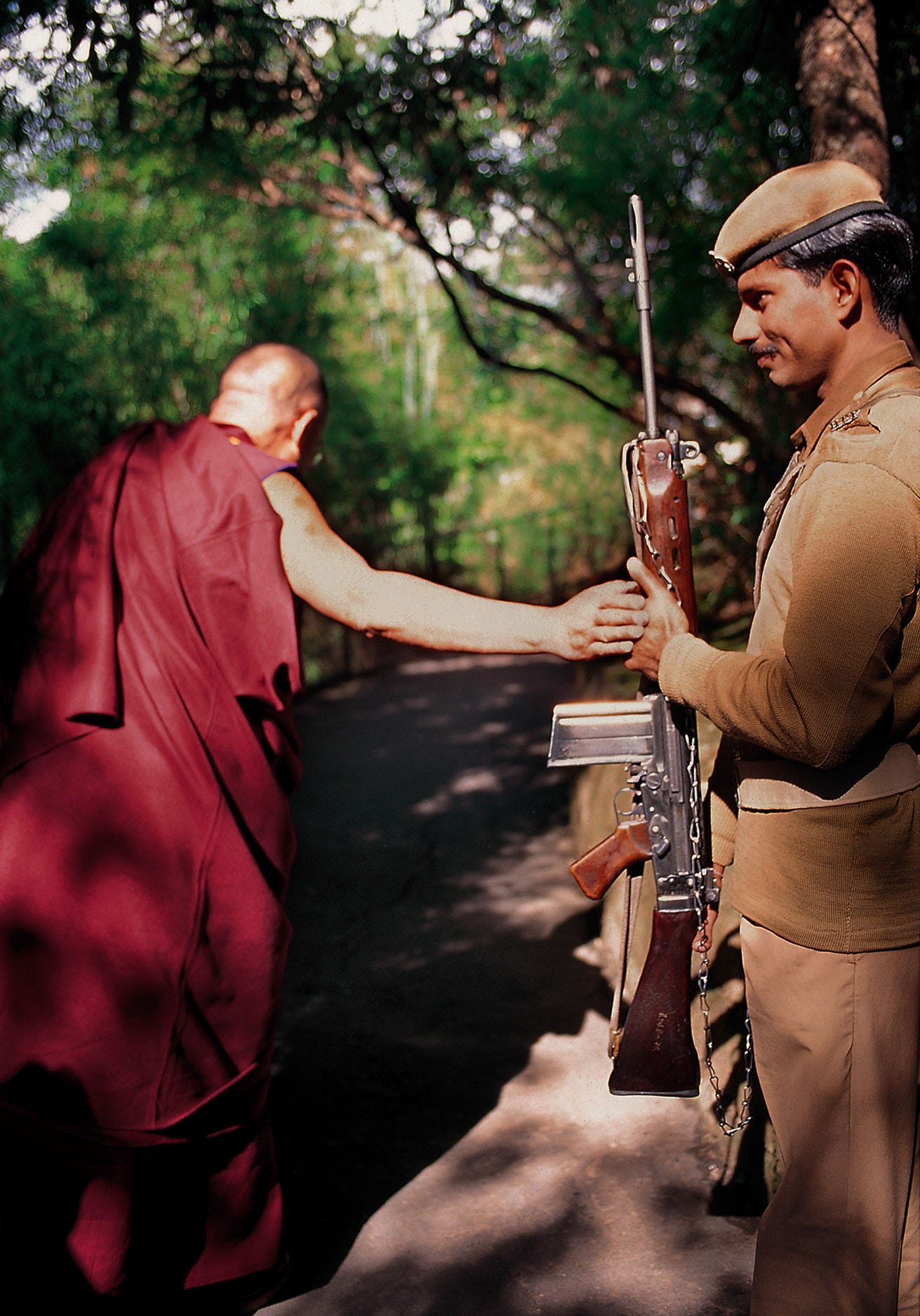
© Alison Wright with the Dalai Lama
What I keep is a long lunch at Le Zinc and her gratitude, handed back to me across the years, for a gesture I had thought small enough to forget. She had traced it to its source the way the man in the elevator traced his scar. Both of them carried the thread its whole length. Both held out the far end of something I had released the instant I set it loose.
And in the recognition, something turns over. The man in the elevator had been alive to that field for twenty plus years, more alive to it than I had been since the afternoon it happened. Alison carried her gratitude just as long. The harm and the gift travel the same way, untraceable, disproportionate, handed off and gone. The person carrying your forgotten sentence is, right now, alive to it. You will keep doing this, today, in ways you will not see. The untraceability is not only a loss. It is the condition under which we are continually handing one another the proof of being alive, and almost never finding out.
That is reason enough to stay awake at the cause.