

There are ten structures here, more or less, shacks and sheds and small buildings on less than an acre in the middle of town. I am not going to say where. If you create here, you already know, and if you do not, it is enough to know that a place like this still exists, on ground that everyday conversation in this town assumes someone will eventually want.
The potluck table is set by five thirty. At its center someone has placed a full head of purple cauliflower, whole and untrimmed, the way a magazine would style it, and around it the food gathers: local wine, fruit drinks somebody made at home, mead from friends just down the avenue. Nobody arranged the table to look like that. It arrived that way, dish by dish.
Between the eating and the music, the doors stay open. Nothing is announced. You wander into a studio because the person who works there is standing in it, and they show you what they are making because you asked, and then you wander out again.
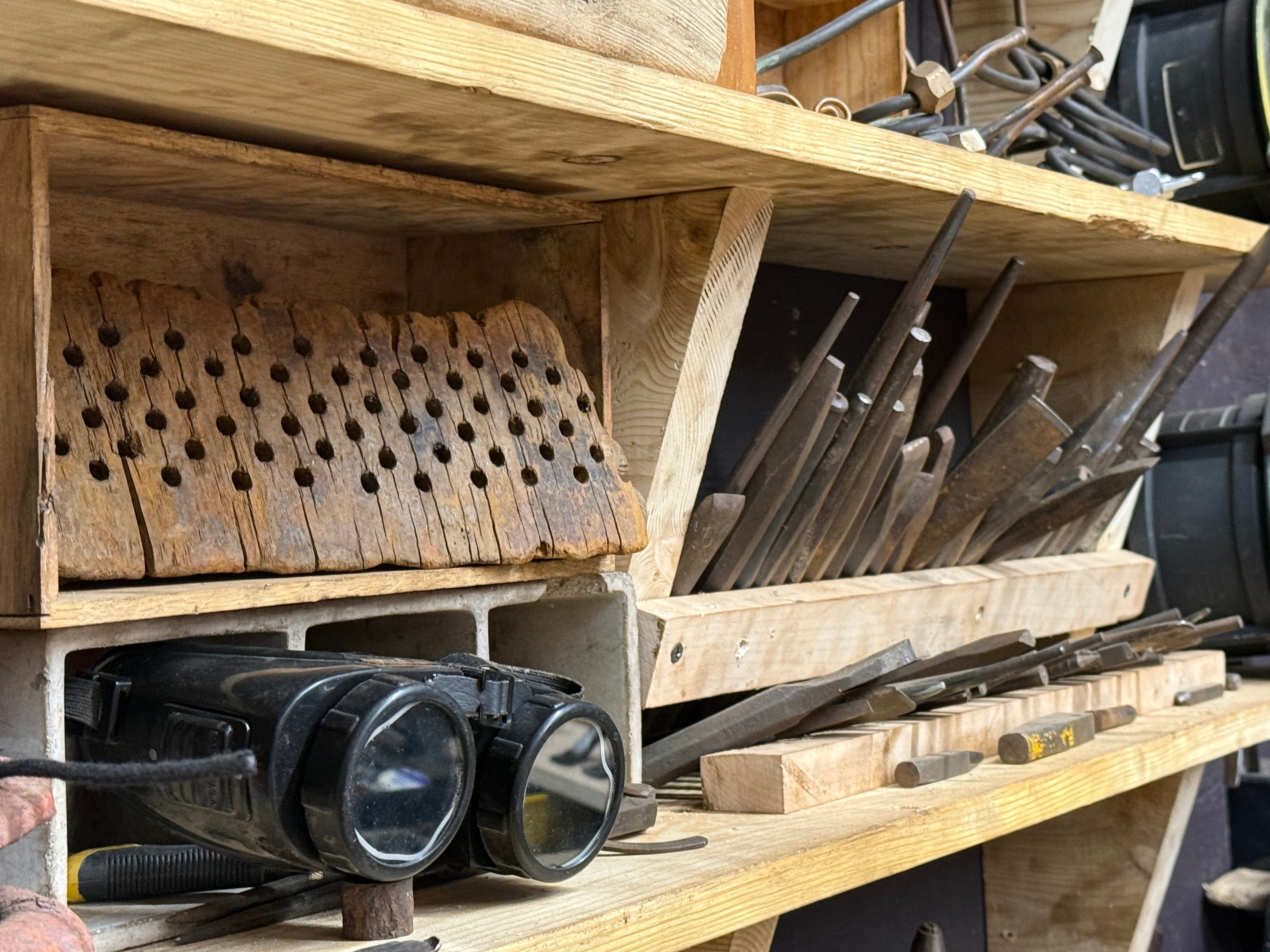
The metalsmith’s shop is quiet when we arrive. The tools are put up for the evening: chisels standing in their wooden rack, punches laid in rows, a pair of welding goggles on a shelf beside a block of old wood gone soft at the edges, studded with nail holes, kept for no reason a stranger could name.
Then one of the sons wants to cut a rod.
The rod comes out glowing and is set into the hole of the anvil, and the boy bangs until it snaps. The sound carries across the whole property. Nobody looks up for long.
The music starts at six thirty. The first singer sits on a stool on the makeshift boards that serve as a stage in front of one of the cabins, legs crossed, guitar in her lap. She is ready to begin and then she is not, because a train is coming through, and she waits for it, the whole crowd waiting with her, until the last car passes and she starts to sing.
The songs are about people she used to love.
The sitar player follows her, and he sits down cross-legged on the boards, the sitar across his body, an electronic tabla keeping time beside him. The eating slows. For a while the evening is not local.
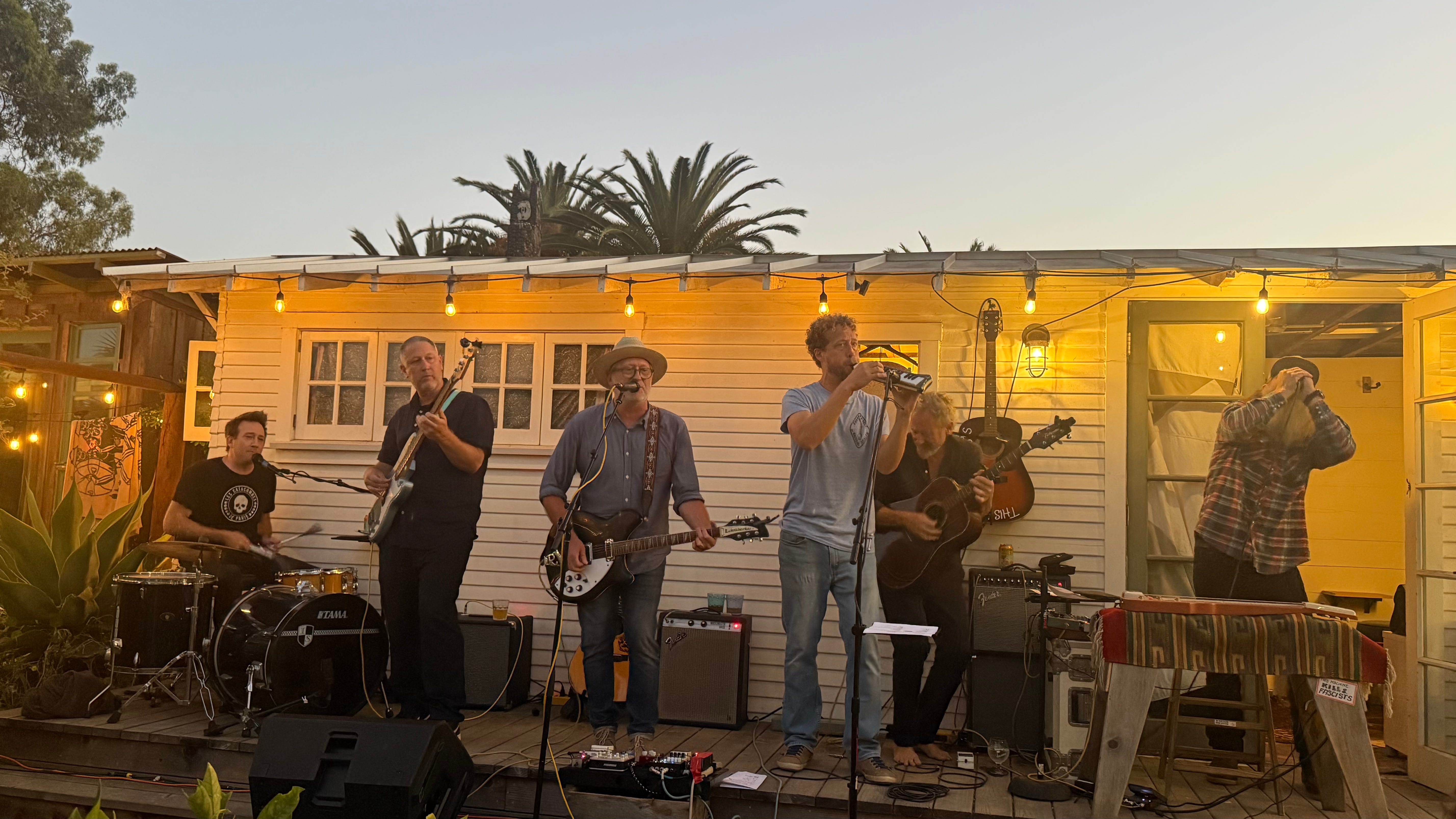
Then the band. Six of them on the porch of a white cabin under string lights, drums, bass, guitars, a harmonica, one of them barefoot. Somewhere in the set they play a song called “Stay Awake.” The light goes down behind the palms while they play, and the porch gets yellower, and the dark arrives without anyone remarking on it.
Less than an acre.
That is the whole of it: ten structures, a strip of boards for a stage, a table.
Every planner in California could tell you what this land is worth, and they would be measuring the wrong thing.
What the acre holds is not square footage.
It is permission.
A place where a boy can heat a rod and bang it until it snaps. Where a woman can wait out a freight train with a guitar in her lap. Where a man can sit cross-legged among his neighbors and play an instrument most of them cannot name.
None of this requires the acre to be beautiful or the buildings to be sound. It requires only that the ground stay still long enough for people to learn what they can do on it.
That is harder to come by than it sounds.
We speak about space as though it were neutral, as though an empty lot were simply unused and a building simply occupied. But space is never only physical. It carries instruction
A sidewalk tells you to keep moving. A store tells you to buy something. A lobby tells you to wait. A classroom tells you where to sit. A concert hall tells you when to clap. A city park may appear open, but signs, fences, hours, surveillance, and design tell you exactly what kind of openness is permitted.
Some spaces allow activity.
Fewer allow possibility.
This acre does not tell anyone what to become. It does not offer a program. It does not announce a workshop in creativity or a seminar in belonging. It does not ask anyone to register.
A child sees a tool and wants to use it.
A stranger walks through a doorway.
A singer waits for a train.
The important things happen without being organized into importance.
We have grown accustomed to believing that creativity requires infrastructure in the obvious sense: funding, institutions, equipment, curricula, venues. Often it does. But before any of that, it requires something simpler and more difficult to protect.
It requires room.
Not only room in the physical sense, but room to begin without knowing what the result will be. Room to be bad at something. Room to make noise. Room to leave materials unfinished. Room to ask a question without becoming a customer. Room to spend time on an activity whose value cannot yet be explained.
The acre offers this kind of room.
It is not empty. It is unresolved.
That may be its greatest value.
Human beings need places that have not already decided what we are supposed to do in them.
My grandfather was an engineer, an inventor. He once told me that the downfall of the American republic would be the lack of garages.
He had blown up his own garage twice.
This was not metaphorical. He believed in experimentation with enough conviction to damage the structure that contained it.
At the time, his warning sounded comic and oversized. Now I think he understood something precise. The garage was not merely a place to keep a car. It was a zone of tolerated disorder. A room where a person could make noise, leave tools out, ruin materials, test an idea, fail, and begin again without first persuading an institution that the attempt was worthwhile.
The garage gave invention somewhere to happen before it became useful.
Most experiments conducted there did not become companies. They became broken parts, scorched walls, repaired machines, engines that never ran properly, and stories told later at dinner. That was not wasted effort. It was practice in acting upon the material world.
A society loses something when every square foot must be clean, safe, rentable, insurable, and economically justified. It loses the places where curiosity can become competence, where failure can remain local, and where a person can discover what they are capable of without asking permission.
My grandfather was not arguing for garages as architecture.
He was arguing for room to blow something up.
We need fields, porches, workshops, gardens, beaches, courtyards, sheds, vacant lots, and tables under the open sky. We need places where the body is not being moved through a transaction. Places where there is no correct duration for staying. Places where silence and noise can take turns.
We need somewhere to emerge from our rooms.
This need is easy to dismiss because it sounds soft. Soulful. Unmeasurable.
But the effects are physical.
The body lowers its guard.
The eyes move farther.
The nervous system begins to register wind, temperature, distance, approaching darkness.
Conversation stretches because nobody is waiting for the table.
A child learns by watching an adult’s hands.
A stranger becomes familiar through repetition.
The ordinary world becomes dimensional again.
These are not decorations on a life. They are part of how a life becomes livable.
The outdoors matters because it loosens the edges around us. Indoors, every object has been placed. Every surface implies a use. Walls contain sound, bodies, movement, and sight. Outside, the world exceeds the frame.
A train passes through the performance.
Light leaves in the middle of a song.
The air changes.
A bird crosses where no one intended it to.
The evening refuses to be managed.
This is part of what sacred space has always offered, even before anyone built a structure and named it holy. The sacred may begin in a place where control weakens.
A grove.
A shoreline.
A clearing.
A patch of ground where people gather and become quiet for reasons they did not plan.
Nothing supernatural has to occur.
The singer waits.
The crowd waits with her.
The train takes the time it takes.
Then the music begins.
For a moment, nobody is competing with the world.
That may be one way the sacred enters modern life. Not as doctrine. Not as spectacle. As the temporary suspension of utility.
For a few hours, the acre is not being asked to produce the highest return. The musicians are not background entertainment. The meal is not a purchase. The studios are not retail spaces. The people are not customers.
They are present together.
The place does not feed the soul because it is picturesque. It feeds the soul because it allows the self to become less defended.
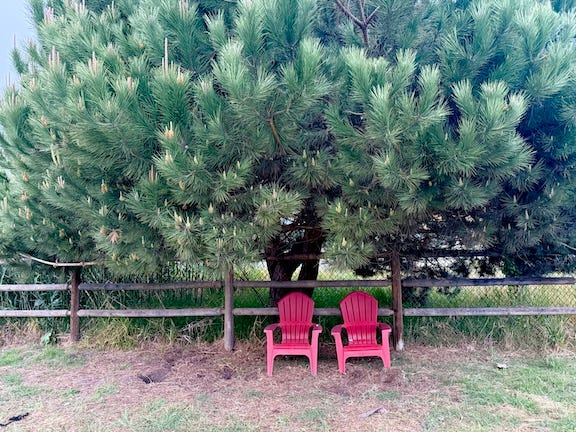
There are places where this happens almost at once. A beach before the crowds arrive. A forest path where the canopy changes the light. A community garden behind an apartment building. A two red plastic chairs under a tree that nobody thought important enough to remove.
The place does not have to be remote.
It has to permit a different scale of attention.
The head of purple cauliflower at the center of the table matters for this reason. So does the mead. So do the nail holes in the old block of wood.
None of them were placed there to become symbols.
They became meaningful because they were allowed to remain ordinary long enough to be noticed.
Community in this country is spoken of as if it were a program, something to be built, funded, convened.
It is not built.
It accrues.
It accrues the way the metalsmith’s block of old wood accrued its nail holes, one small act at a time, each act depending on the ground beneath it not having changed since the last.
Someone returns.
Someone brings food.
Someone fixes a hinge.
Someone leaves a tool where another person can find it.
Someone remembers which song was interrupted by the train.
A gathering can be created in an evening.
Belonging requires the possibility of another evening.
This is why space and time cannot be separated. A place becomes meaningful not only because of what happens there, but because people trust that it will still be there when they return.
The ground remembers through repetition.
The people do too.
Take the ground and the accrual stops.
This is the part no development proposal can fully calculate.
A parcel can be measured. A structure can be assessed. A project can estimate units, parking spaces, tax revenue, traffic, density, and return.
But nobody lists the permissions that will disappear.
The right to make noise.
The right to linger.
The right to begin badly.
The right to store strange materials.
The right to leave a piece of old wood on a shelf because it has been there for years and no one has found a reason to throw it away.
The right not to finish.
We have become skilled at building open space while removing openness.
New developments include courtyards, terraces, pathways, and common areas. They photograph well. A tree is placed beside a bench. String lights suggest intimacy. A fire pit suggests community.
But design cannot manufacture belonging.
A shared area is not the same as shared life.
Many new spaces carry an invisible demand to behave correctly. Do not repair anything here. Do not play too loudly. Do not leave materials out. Do not bring in work that smells, sparks, stains, or takes years to complete.
The space is available, but permission has been removed.
There are public plazas where sitting too long attracts suspicion. Parks with no shelter from the sun. Sidewalks designed only for passage. Landscapes visible from the road but inaccessible on foot. Outdoor space maintained so carefully that no one can leave a mark on it.
We praise cleanliness and order, then wonder why a place feels dead.
The old block of wood in the metalsmith’s shop would not survive most redesigns.
It would be discarded before anyone could explain what it held.
Still, the argument is not simple.
Towns need housing. People need places to live. California does not suffer from an excess of affordable rooms. Preserving one person’s refuge can become another form of exclusion. A beloved informal compound may occupy land in a place where families are being displaced and workers commute long distances because they cannot live near their jobs.
The need for space is universal.
Access to it is not.
Some people have yards, porches, gardens, trails, and quiet streets. Others live beside freeways, warehouses, heat islands, flood channels, and roads that are dangerous to cross. Some people can drive to beauty. Others watch green space through a fence.
It would be dishonest to treat this acre as proof that everything should remain as it is.
Land changes.
Cities change.
People need shelter.
The question is not whether development should occur. The question is why development recognizes so few forms of value.
Could housing be built without erasing gathering?
Could density include workshops, gardens, courtyards, shared tools, outdoor stages, and places where no purchase is required?
Could planners treat cultural continuity as infrastructure rather than decoration?
Could we create homes that give people more than an interior unit and a parking space?
We behave as though shelter alone constitutes a life.
It does not.
People need rooms.
They also need somewhere to emerge from them.
The deepest value of the acre is not that it has resisted change. Its value is that it reveals what change so often forgets.
Human life does not happen only inside designated uses.
It leaks.
It gathers around tables.
It crosses thresholds.
It makes noise at the wrong time.
It leaves tools out.
It turns work into teaching and strangers into witnesses.
It requires edges soft enough for one kind of life to meet another.
The acre is not a park, though there are trees.
It is not a school, though children learn here.
It is not a church, though reverence arrives.
It is not a concert hall, though people listen closely.
It is not a market, though things are made.
It is not a home, though people belong.
It works because it has not been reduced to one of these.
Its indeterminacy is not a planning failure.
It is the source of its life.
By the time the band plays “Stay Awake,” the dark has settled around the buildings. The string lights hold only the porch and the people nearest it. Beyond them, the rest of the property recedes.
The music carries farther than the light.
The flyer for the evening encouraged everyone to come by train. The last one back leaves at 9:35, and people begin to peel away before the music is quite finished, calling their goodnights in the dark, walking toward the station.
The band plays on behind them.
The conversation earlier had turned to development the way it always does here, and then it turned back to the food, because the food was there and the evening was not over.
Nobody needed the argument completed.
The place itself was making it.
Less than an acre.
A few buildings.
A table.
A stage made of boards.
Enough room for people to discover what they can do when the ground beneath them is permitted to remain uncertain.
I listen for the trains now.
Beautiful. Thank your insight and poetry.